
Guest Blog: Foundations of Numeracy Part 2
In Part 1 of this series, Jillian Mendoza of PowerMyLearning introduced the Foundations of Numeracy framework and made the case for how it can sharpen curriculum decisions and build coherence across math programs. If you haven't read it yet, start there — it lays the groundwork for everything that follows.
In this second installment, Jillian turns to two of the places where the framework is most urgently needed and most often missing: intervention design and teacher professional learning. If your school or district is serious about closing math gaps, this is where the rubber meets the road.
From Framework to Practice: Using the Foundations of Numeracy to Lead Research-Backed Math Instruction
Part 2: Designing Intervention and Sustaining Professional Learning That Actually Works by Jillian Mendoza, Director of Math
A guide for principals, instructional coaches, and district leaders
Decades of research on how students learn math have converged on a clear picture: lasting numeracy doesn’t come from any single program or approach. It comes from coherent, system-wide decisions grounded in a shared understanding of what students actually need. PowerMyLearning’s Foundations of Numeracy framework organizes that research into four cornerstones — Competencies, Content, Ways of Thinking, and Motivators — that together define mathematical proficiency in the early years.
If you’ve already read Part 1, you’ve seen how the framework can sharpen curriculum selection and build coherence across programs. In this installment, we turn to two of the places where the framework is most urgently needed and most often missing: intervention design and teacher professional learning.
Designing and Targeting Intervention
The Foundations of Numeracy is especially powerful as a diagnostic lens for intervention. Too often, math intervention is defined by what students got wrong, without identifying why. The result is intervention that re-teaches surface-level procedures without addressing underlying gaps in the foundations.
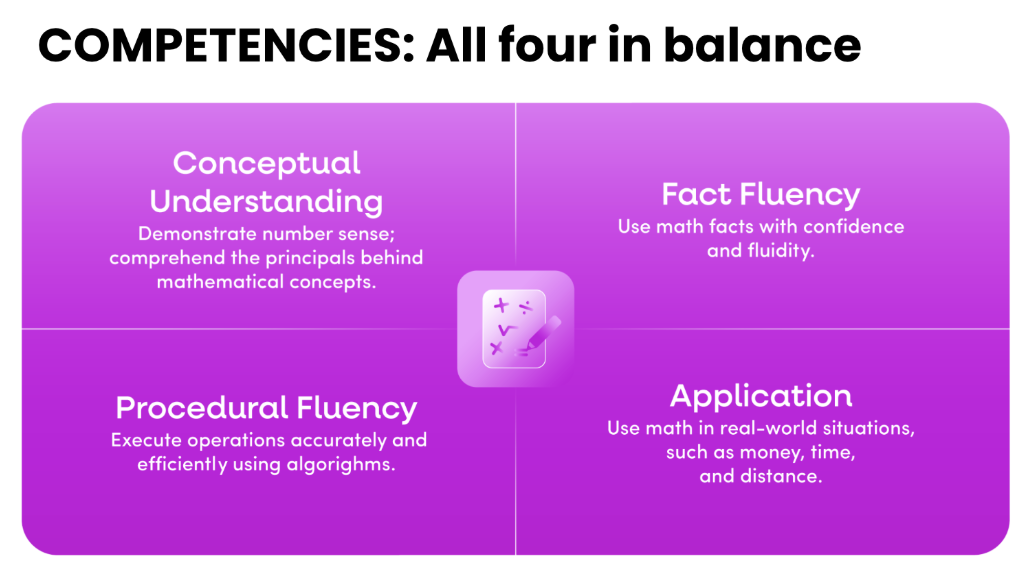
Intervention isn’t one-size-fits-all. A student may be strong in fact fluency but struggle with application, or grasp concepts without procedural accuracy. Identifying which of these four competencies needs support allows educators to intervene with precision.
The framework gives interventionists and coaches a more precise diagnostic frame. A student who struggles with multi-step word problems may have a gap in application, or in conceptual understanding of the relevant content area, or simply in fact fluency — which is dragging down their working memory and preventing them from attending to the problem structure. Knowing which building block is the root cause changes the intervention entirely.
DISTRICT LEADERSHIP USE CASE: Intervention Program Alignment
Require that any new intervention program under consideration demonstrate which of the 16 building blocks it targets, at what intensity, and with what evidence. Programs that only address procedural fluency are unlikely to address the root causes of persistent math gaps.
INSTRUCTIONAL COACH USE CASE: Student-Level Diagnostic Conversations
When reviewing benchmark data with a teacher, use the cornerstone framework to move the conversation from “This student scored below grade level,” to “This student shows strong fact fluency, but inconsistent conceptual understanding of fractions. Let’s look at what that means for Tier 2 support.” This specificity leads to more targeted and effective intervention plans.
PRINCIPAL USE CASE: Scheduling Intervention Time That Targets Root Causes
When building the master schedule, ensure that intervention blocks are long enough to address conceptual gaps, not just fact fluency. Fifteen minutes of daily fact practice is valuable, but it cannot compensate for underdeveloped number sense. Build in time for number talks and small-group conceptual work.
Supporting Teacher Professional Learning
The Foundations of Numeracy framework is a powerful tool for professional learning. When teachers understand the full picture of numeracy, they are better equipped to make in-the-moment instructional decisions, design tasks that develop multiple building blocks at once, and interpret student work as evidence of specific strengths and gaps rather than general “understanding” or “confusion.”
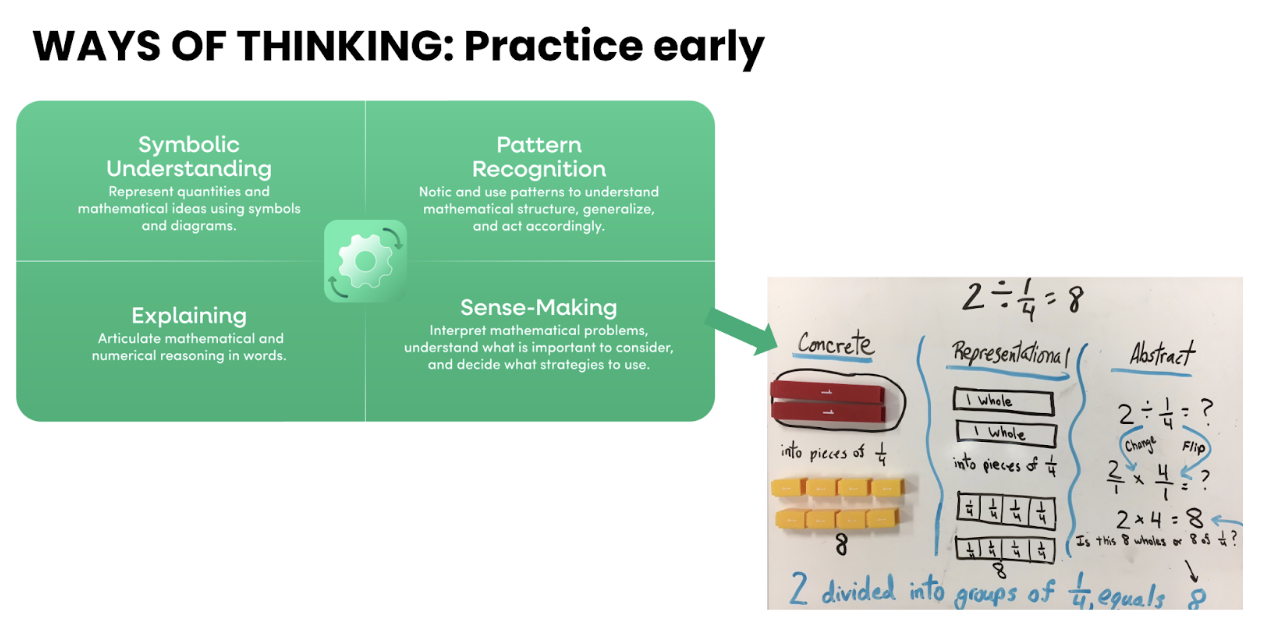
Ways of Thinking influence how students access math content. Tasks may target ways of thinking directly, or build them naturally through content-based work. No cornerstone stands alone; all four work together.
The framework supports the Concrete-Representational-Abstract (CRA) progression that research identifies as particularly effective for building conceptual understanding. Incorporating CRA within learning experiences makes math learning equitable by providing opportunities for students to reason about mathematics using various representations. Teachers who understand why CRA works — because it grounds abstract symbols in meaningful representations — are more likely to use it consistently and skillfully than teachers who simply follow a curriculum’s pacing guide.
INSTRUCTIONAL COACH USE CASE: Classroom Observation Protocol
Develop a brief observation tool organized by the four cornerstones. During walkthroughs, note which building blocks are being actively developed in the lesson, and which are absent. Use this data across classrooms to identify school-wide professional learning priorities, not just individual teacher coaching needs.
DISTRICT LEADERSHIP USE CASE: Professional Learning Scope and Sequence
Design a multi-year professional learning scope and sequence that addresses each cornerstone in depth. Year 1 might focus on the Competencies and what balanced instruction looks like in practice. Year 2 might focus on Content progressions — particularly fractions — and how to identify and address gaps. Year 3 might focus on Ways of Thinking and the Motivators, building classroom culture alongside content knowledge.
From Awareness to Action
The stakes could not be higher. Only 22% of 12th graders in the United States are proficient in math, a number that reflects not a single failure, but years of fragmented decisions made without a shared map of what students actually need. Behind that statistic are real students: kids who arrived in middle school without number sense, who were placed in intervention programs that re-taught procedures without addressing conceptual gaps, whose teachers were given conflicting messages about what good math instruction looks like.
When every stakeholder — from the superintendent selecting curriculum to the coach leading a PLC to the interventionist working with a struggling third grader — is oriented around the same comprehensive picture of numeracy, decisions compound in the right direction. Students stop falling through the cracks between programs. Instruction stops oscillating between philosophies. And the gap between what we know from research and what actually happens in classrooms finally starts to close. Our students have never needed that coherence more than they do right now.
Read more about the Foundations of Numeracy here.
