
The Question We Only Ask Too Late
My second year of teaching, I taught first grade in the AV storage room off the media center. Twenty-one six-year-olds. Shelves of old equipment. No windows. Desks packed so tightly I almost had to turn sideways to walk between them.
I had no pre-service coursework in special education. No real preparation for intervention. No framework for designing instruction for students with significant learning needs. Just a lot of heart, a whiteboard, and a growing sense that I was failing kids who deserved more.
So I started digging.
I read everything I could find. I studied intervention models. I learned about progress monitoring. I dove into special education law. And eventually, after years of coaching, leading district-level math intervention, and working with schools across North America, I kept arriving at the same uncomfortable question.
Why do we wait so long to ask the most important question?
The Question Special Education Has Always Asked
When a student qualifies for special education services and an IEP team sits down to write goals, there is a discipline to that process that general education intervention rarely replicates.
Before anyone writes a goal, the team is supposed to identify the priority educational need, the domain of learning most directly driving the student's difficulty. Not every skill that's missing. Not a laundry list. The priority. The place where targeted, intentional instruction will have the most consequential downstream impact on everything else.
It's a good question. A precise question. A question that prevents a team from writing goals aimed at symptoms instead of roots.
And we only ask it after a student has been referred, evaluated, and found eligible for special education services.
I want to ask it earlier.
What We Do Instead
Walk into most schools and ask how students struggling in math are placed in intervention. Here's what you'll often find:
Students get the intervention the building has. Or more of the same core instruction, just s l o w e r and LOUDER.
And then we wonder why the data doesn't move.
This isn't a criticism of educators. It's a criticism of systems. Most schools have not been given the tools to ask the right diagnostic question before assigning a response. Instead, intervention gets assigned based on screener scores, teacher referral, or whatever program arrived with last year's grant funding.
The presenting problem and the root cause are rarely the same thing. In math intervention, we often treat one while leaving the other untouched.
The Reading Parallel
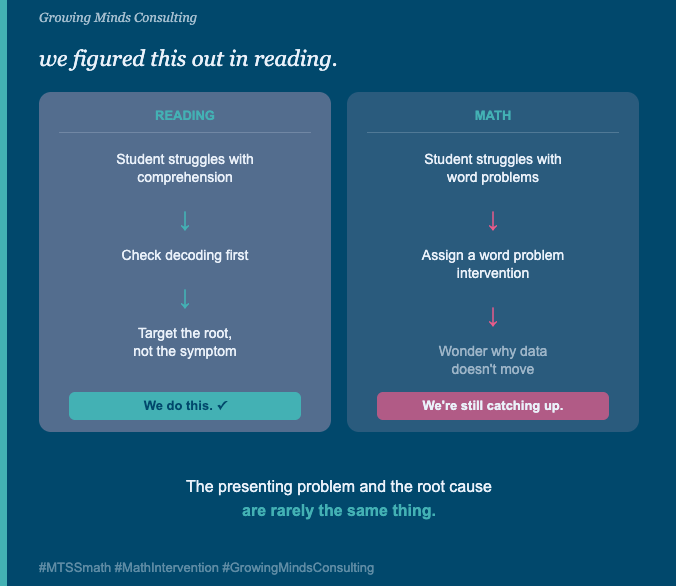
Most educators immediately understand this concept when it's framed in terms of reading.
You wouldn't give a reading comprehension intervention to a student who can't decode. Everyone nods at that sentence. Because in reading, we figured out that the presenting problem — struggling to understand what they read — is not always the root cause. Sometimes the root is decoding. And if you never address decoding, comprehension instruction goes nowhere.
Math has the same structure. We just haven't been as systematic about naming it.
A student who struggles with word problems might actually be missing a stable sense of what fractions are as numbers.
A student who struggles with multi-digit multiplication might be missing place value understanding from two grades ago.
More practice on the top floor does not fix a crack in the foundation. You have to find the break first.
Priority Educational Need — Applied Upstream
The framework I've been building is grounded in a concept borrowed directly from special education practice and applied upstream — to every student who needs more than core instruction, not just the ones who've already crossed the eligibility threshold.
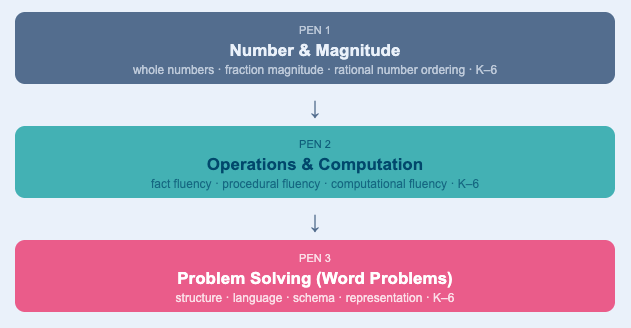
It asks MTSS teams to identify the Priority Educational Need before designing any intervention response. And it provides a rule-out sequence, not a checklist of every skill a student is missing, but a disciplined order of operations for finding the root.
Number & Magnitude first.
Can the student reliably understand what numbers mean — their size, their relationships, their place in a progression? This includes whole numbers in the early grades and extends to fraction magnitude, decimal magnitude, and rational number ordering in the upper elementary and middle grades. If this foundation isn't solid, everything built on top of it — computation, procedures, problem solving — is unstable.
Operations & Computation second.
If number and magnitude are solid, the question shifts to how students operate on numbers. And here, it matters a great deal which kind of fluency is breaking down. Fact fluency, procedural fluency, and computational fluency are not the same thing, and they don't call for the same response. Assigning timed fact drills to a student with a procedural bug is like giving a student decoding worksheets when their real issue is phonemic awareness.
Problem Solving third.
Only after the first two have been ruled out (or confirmed as sufficiently stable) does the team turn to word problems and mathematical reasoning. If both earlier domains are addressed and the student is still struggling with problem solving, the barrier is likely language, problem-type structure, representation, or multi-step planning. And that calls for explicit, schema-based instruction — not keyword strategies, which have been shown to be ineffective and which I'd put at the top of any math intervention naughty list.
The Part That Stays With Me
Here's what I keep coming back to, and it's the part that feels most urgent.
If we ask the right diagnostic question earlier — for every student who's struggling, not just the ones who've already been referred — we don't just get better interventions. We likely get fewer students reaching eligibility in the first place.
A lot of what gets documented as a math learning disability is, in reality, a record of interventions that never targeted the actual root. The program the building had. The strategy aimed at the symptom. Years of support that missed the break in the progression.
That's not a disability. That's a systems failure we have the tools to interrupt.
The IEP process asks the right question. It's just asking it three years too late.
No child should have to wait for an eligibility determination to get a precisely targeted instructional response to their most urgent learning need.
That's the work. That's why I built this.
What's Coming
I've been developing a K–6 Math Intervention Decision Tree organized around the Priority Educational Need framework. It's designed to be used in MTSS team meetings — by coaches, interventionists, general education teachers, and administrators — to identify the right target before naming a response.
It includes cornerstone skills at every grade level, earlier-grade alert flags for the cross-grade prerequisites that quietly block current progress, quick probes, error pattern guidance, first instructional responses, and progress monitoring suggestions.
I'm not releasing the full tool yet. But I am ready to talk about it.
If you're a district or school leader thinking about how to build more precise, effective math intervention systems — I'd love to connect.
