

Grow Your Mind
Three Rooms, One Argument
When a student isn't succeeding in math, what do we change first?
Most systems answer that question the same way. We change the student's placement: a new group, a new program, a new tier, more minutes of the same thing delivered more slowly. It happens with the very best of intentions, and it rarely works, because it treats the student as the variable when the variable is almost always the design.
The Question We Only Ask Too Late
I taught first grade in a storage room. Twenty-one six-year-olds, no windows, and students with significant learning needs I had no training to address. That experience sent me on a path I'm still walking — and it keeps bringing me back to one question: why do we only ask the most important diagnostic question in math after a student has already been found eligible for special education? That question belongs earlier. For every student. Before the referral. Before the label.
Guest Blog: Foundations of Numeracy Part 1
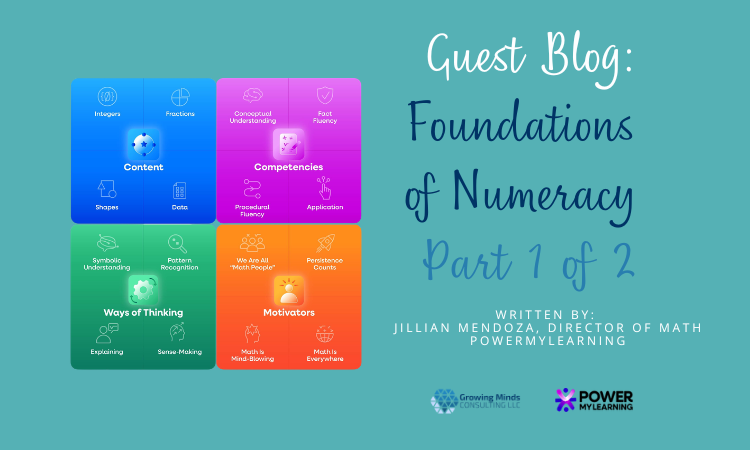
Decades of research have converged on a clear picture of what students need to build lasting mathematical proficiency — but translating that evidence into coherent, school-wide action is where many systems fall short. In this guest post, Jillian Mendoza, Director of Math at PowerMyLearning, introduces the Foundations of Numeracy framework: a research-backed map for making smarter decisions about curriculum, intervention, and instructional coherence. Whether you're a principal, instructional coach, or district leader, this framework gives you a shared language for evaluating every math decision — not just a slice of it, but the whole picture.