
Three Rooms, One Argument
When a student isn't succeeding in math, what do we change first?
Most systems answer that question the same way. We change the student's placement: a new group, a new program, a new tier, more minutes of the same thing delivered more slowly. It happens with the very best of intentions, and it rarely works, because it treats the student as the variable when the variable is almost always the design.
That's the argument I'm bringing to Denver this October, three times, at three different altitudes. One session is for the leaders who design intervention systems. One is about the classroom culture that decides whether a student will risk a wrong answer. One is about the math lesson itself. Different rooms, different audiences, same belief: when students aren't accessing or engaging with the learning, it's the design that needs to be adjusted, not the learner.
Here's where to find me, and what each session is really about.
Where to Find Me in Denver
NCSM 58th Annual Conference
Math MTSS in Motion: Tools, Tiers, and Targeted Support (Session 058)
Wednesday, October 28, 7:45 to 8:45 a.m. MDT
Governors Square 10, Sheraton Denver Downtown
NCTM 2026 Annual Meeting & Exposition
Helping Your Students S.H.I.N.E. in Math (Session 311), with Liesl Sisson
Friday, October 30, 9:30 to 10:30 a.m. MDT
Colorado Convention Center, Room 304
Math for All: Translating Universal Design for Learning Into Math Practice (Workshop 465)
Friday, October 30, 2:45 to 4:00 p.m. MDT
Colorado Convention Center, Room 205
1. The System: Math MTSS in Motion (NCSM)
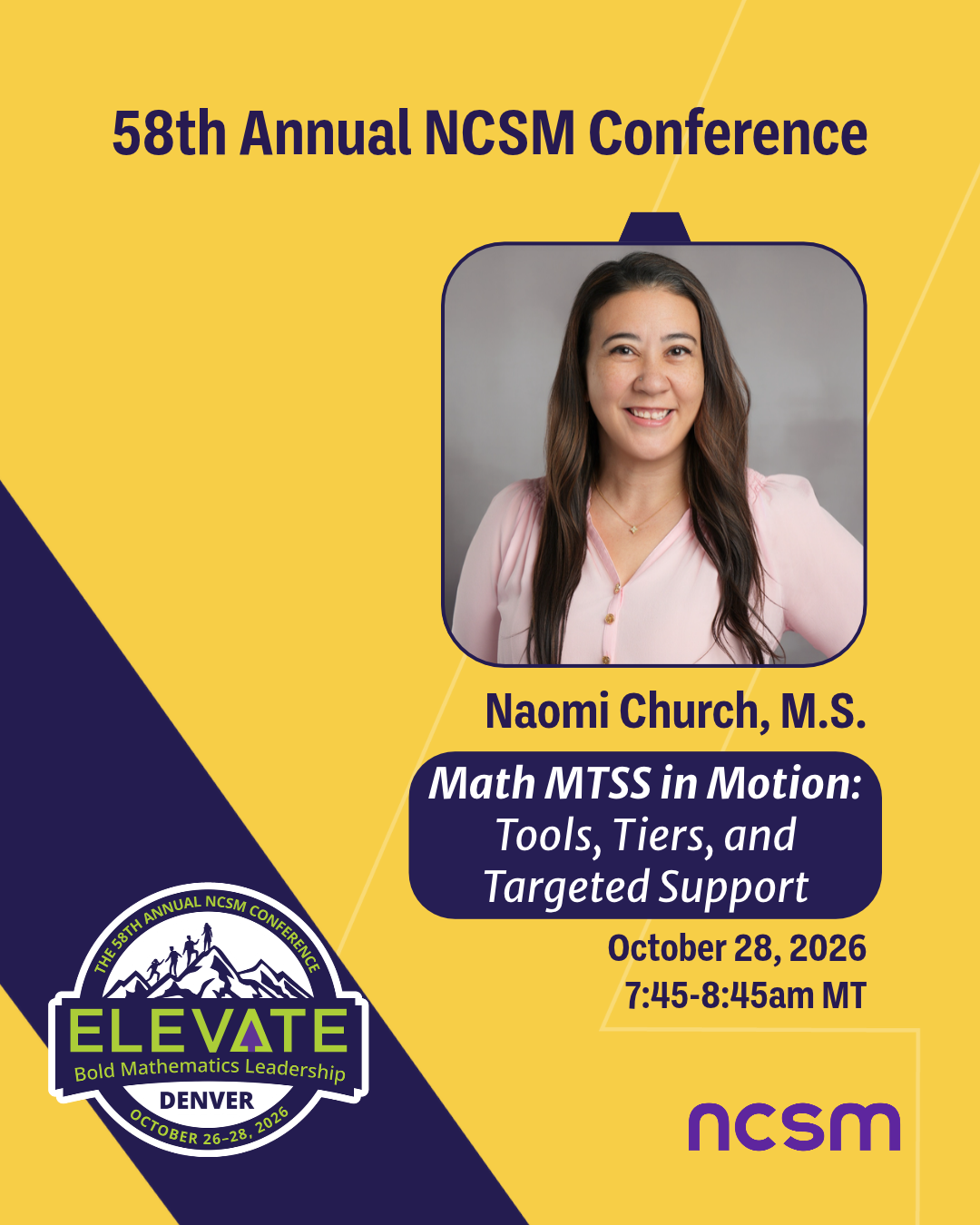
Yes, it's 7:45 in the morning on the last day of NCSM. Bring your coffee. It's worth it, I promise.
Here's what I know from leading K–12 math intervention in the sixth-largest school district in the nation: when too many students land in Tier 2 and Tier 3, the instinct is to add more intervention. More minutes, more pull-outs, more programs. But you can't intervene your way out of a Tier 1 problem. An intervention system is only as strong as the core instruction underneath it, and the tiers only make sense when everyone understands them as what they are: resource allocations, not categories of kids.
This session is built for district leaders, school administrators, and coaches, the people who decide how support gets structured, staffed, and funded. We'll look at how to read your own data for systemwide math needs before anyone buys anything, and how to build tiered structures that hold up when the grant ends and the staffing changes. Then we'll get specific about intervention itself, anchored in four guidelines:
Target the priority educational need. Number sense, then computation, then problem solving. In that order. Most interventions skip the order, and a problem solving intervention can't fix a number sense gap.
Use systematic, teacher-directed instruction. Students with persistent difficulty need explicit, responsive teaching focused on the exact skill blocking their progress (Fuchs et al., 2021). Not a parent volunteer or a peer buddy or a computer program running in the corner.
Progress monitor frequently and skill-specifically. If the intervention targets one skill, the progress monitoring data should show whether that exact skill is improving. A unit test can't tell you that.
Implement consistently without losing coherence. Intervention that never connects back to core instruction becomes a side system, and students rarely carry what they learn there back into the classroom.
Tier 2 and Tier 3 in MTSS should not be a life sentence. A well-designed system is how you make sure they aren't.
2. The Culture: Helping Your Students S.H.I.N.E. in Math (NCTM)
Ask a room of students what happens when they get a math problem wrong, and a lot of them will describe some version of embarrassment. So they stop volunteering. They copy the answer off the board. They wait for someone else to go first. A student who is afraid to be wrong in math has quietly opted out of the only process that actually produces learning.
I'm co-presenting this session with Liesl Sisson, who is leading it. Liesl is a former teacher, coach, and principal from Platte County School District #2 in Guernsey, Wyoming, and she holds a master's in mathematics from the University of Northern Colorado. Her work centers on helping people identify and use their strengths, and she delivers it with the kind of humor that makes a message stick long after the session ends. If you've never been in a room with her, this is your chance.
The session draws on the Ignite Your S.H.I.N.E.® framework, which centers strengths, belonging, and agency. In math, that looks like classrooms where a mistake is treated as information rather than evidence, and where students are known for what they CAN do before anyone catalogs what they can't. Nobody is excited to work on things they are bad at. That's true for our students, and it's true for us.
Think of Ms. Frizzle: take chances, make mistakes, get messy. Learning is messy, and we learn more from the mistakes than from getting it right the first time. You'll walk away with practical strategies to build that kind of room for your students, and a few to help you S.H.I.N.E. a little brighter yourself.
3. The Lesson: Math for All (NCTM Workshop)
In the early 1950s, the U.S. Air Force had a problem: good pilots were losing control of their planes. The cockpits had been designed around the average pilot's body, so researchers measured more than 4,000 pilots on the dimensions that mattered most. Not one of them fit the average on all ten (Rose, 2016). Design for the average, and you've designed for nobody. The fix wasn't better pilots. It was adjustable seats.
Math lessons are cockpits. Most are still built for an average student who doesn't exist, and then we retrofit supports for the students who don't fit, one accommodation at a time, after the lesson has already missed them. Universal Design for Learning flips that order: plan for the variability you know is coming, and build the adjustable seats in from the start (CAST, 2024).
This is a 75-minute hands-on workshop, and I'm leading it. We'll pull UDL out of its framework language and into math-specific moves: removing barriers that have nothing to do with the math, offering multiple ways into a task without lowering the ceiling, and giving students real voice and choice in how they show their thinking. We'll also look at how something as small as the words we use changes access. A "hard problem" feels like a threat. Call the same set of problems mild, medium, and spicy, and suddenly it's a challenge students choose. Same math, different semantics.
When students get real ways in, they start to see themselves as people who do math. Nobody feels included when their only access point is through the back door.
Why Three Rooms
The system decides who gets support. The culture decides whether students will risk being wrong. The lesson decides whether they can get in the door at all. Fix one and leave the other two alone, and students will hit the same barrier somewhere else. That's why I'm glad all three conversations are happening in the same city, in the same week.
Save all three sessions in your conference app, and if our schedules don't line up, come find me in the hallway; I'd love to hear what you're working on.
We don't fix kids. We fix the design they're learning inside.
References
CAST. (2024). Universal Design for Learning guidelines (Version 3.0).
Fuchs, L. S., Newman-Gonchar, R., Schumacher, R., Dougherty, B., Bucka, N., Karp, K. S., Woodward, J., Clarke, B., Jordan, N. C., Gersten, R., Jayanthi, M., Keating, B., & Morgan, S. (2021). Assisting students struggling with mathematics: Intervention in the elementary grades (WWC 2021006). National Center for Education Evaluation and Regional Assistance, Institute of Education Sciences, U.S. Department of Education.
Rose, T. (2016). The end of average: How we succeed in a world that values sameness. HarperOne.
