I met Amanda Koonlaba, Ed.S., at an Advancing Leaders Collaborative retreat this January. Amanda is the founder of Party in the Art Room and a longtime advocate for authentic arts integration — the kind that treats art as a way of thinking, not a reward for finishing early. In this guest post, she draws on her own history with math (a percentages test she failed and spent years not understanding) to make the case for letting students see math instead of only calculating it. If you teach math, coach teachers, or think about accessible instruction at all, this one's worth your full attention. You can find Amanda on LinkedIn.
Grab Amanda's free resource: 25 Math & ELA Art Lesson Starters →
Let Students See the Math
by Amanda Koonlabab, Ed.S.
I still remember the math test.
It was a percentages test, and I made a zero. Not a low score. Not a “let’s try again” kind of grade. A full-on zero.
The worst part was not even the grade itself. The worst part was that I did not understand what I had missed. The class moved on, and I moved on too, at least on paper. But for years, percentages felt like one of those math ideas that other people understood and I just didn’t.
Now, as an educator who has taught both general education and visual art, I think about that student version of myself a lot. I did not need someone to make math easier by watering it down. I needed someone to help me see it.
That is one reason I care so much about arts integration, especially when it comes to math. Art gives students a way to see relationships, build meaning, and make sense of ideas that can feel abstract when they only live as numbers on a page.
And let’s be real: math can get abstract fast.
Fractions, decimals, percentages, geometry, symmetry, measurement, arrays, patterns, area, angles, and part-whole relationships are everywhere. But students do not always see how they connect. They may be able to follow a procedure one day and completely forget it the next because the idea never became concrete for them.
That is where art can do some heavy lifting.
Arts Integration Is Not “Math, Then Coloring”
When I talk about integrating art and math, I do not mean handing students a worksheet and letting them color it when they finish.
That may be fine for early finishers, but it is not arts integration.
Arts integration happens when the art form helps students understand the math and the math helps give purpose to the art-making. The creative process is not tacked on at the end. It is part of how students explore the concept.
For example, if students are learning about fractions, they can design a paper quilt square divided into equal parts. As they work, they can learn how artists use shape, color, pattern, repetition, contrast, and balance to create a strong composition. Then they can look at their own artwork and ask:
What fraction of my design is blue?
What fraction uses stripes?
Can I convert that fraction to a decimal?
Can I turn it into a percentage?
Now the math is not floating out in space. It is attached to something the student made.
Students care differently when the work belongs to them. A fraction on a worksheet may feel random. A fraction inside their own artwork has a reason to exist.
Students Are Learning the Art, Too
This is an important part of arts integration that sometimes gets missed.
The art is not a trick to make math more fun. The goal is for students to learn through the art form while also learning the art form itself. That means the art vocabulary matters.
If students are creating a quilt-inspired design, they are not only learning about fractions and percentages. They are also learning about pattern, repetition, shape, line, color, contrast, balance, and composition. These words are important because they help students think.
When a student says, “I repeated this triangle shape four times,” that is both art language and math language. When a student says, “I used contrast so this section would stand out,” they are explaining a visual decision. When a student says, “My design feels balanced because the colors repeat on both sides,” they are connecting artistic choices to mathematical structure.
That is where arts integration becomes powerful.
Students are learning how artists make decisions, how those decisions communicate meaning, and how visual structure can help them understand an academic concept more deeply.
So, in a math and art lesson, I want students counting, comparing, calculating, and explaining. But I also want them using words like line, shape, color, pattern, symmetry, balance, contrast, space, and composition. The art form deserves to be taught with the same care as the math concept.
That does not mean every teacher needs to become an art specialist. It does mean we should give students the vocabulary and tools to talk about what they are creating. When students have the language of art, their work becomes more intentional, and their explanations become more precise.
Art Helps Students Understand Part-Whole Relationships
So much of math comes back to parts and wholes.
A fraction is part of a whole. A percentage is part of one hundred. A decimal is another way to name part of a whole. Area can be decomposed into smaller sections. Shapes can be combined, divided, rotated, repeated, and transformed.
Visual art is full of the same thinking: lines become shapes, shapes become patterns, patterns become compositions, and small pieces work together to create something larger. That is why math and art belong together. They are both asking students to notice relationships.
When students create a quilt-inspired design, a symmetrical image, a geometric composition, or a radial pattern, they are organizing space. They are comparing sizes. They are noticing repetition. They are thinking about balance, proportion, and structure.
They may not use all of those words right away, but they are building the mental hooks for them. Then, when the teacher introduces the academic vocabulary, students have something to attach it to. That is the shift I want teachers to see. Art is not a break from mathematical thinking. Art can be the bridge into it.
The Story Matters Too
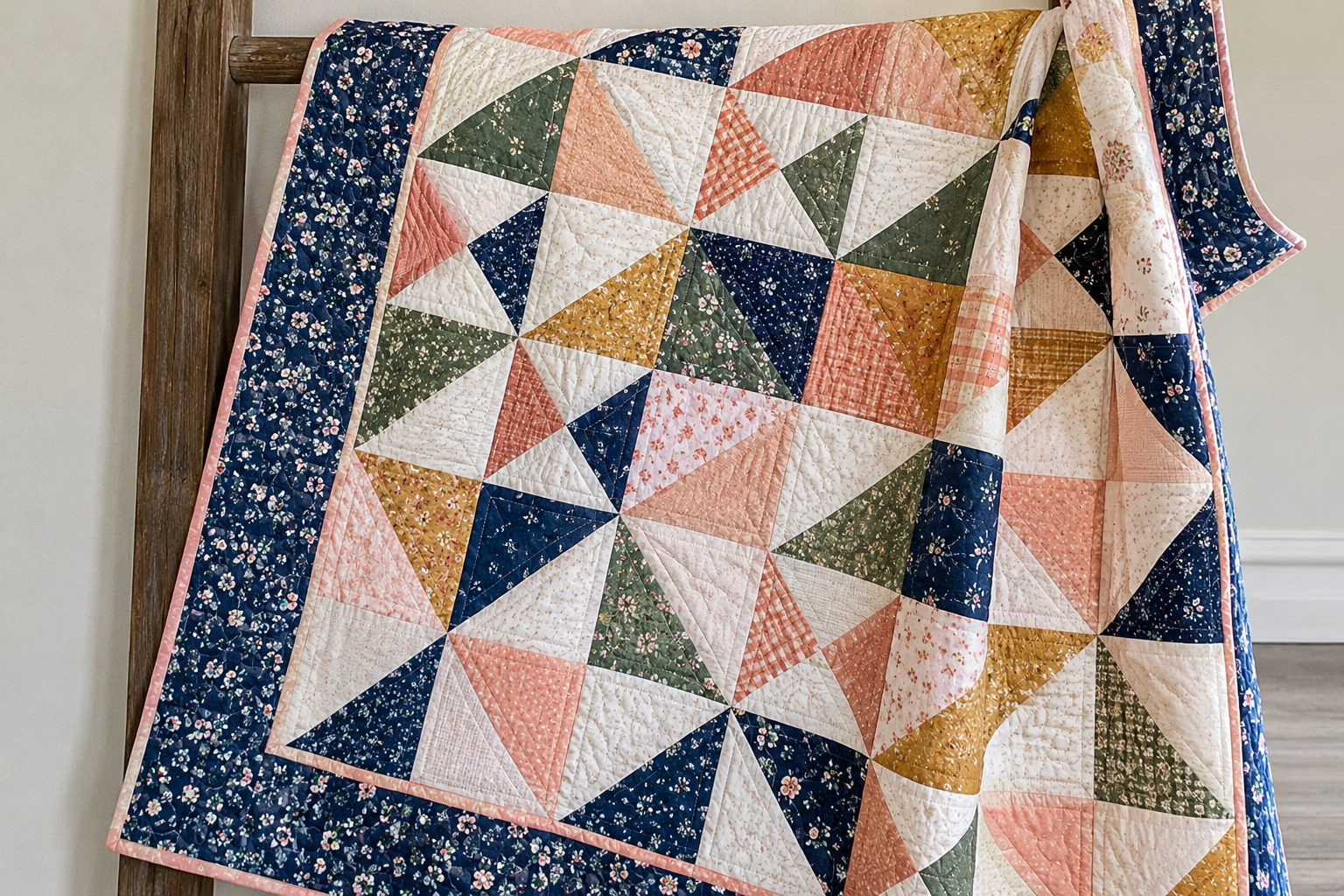
When I teach fraction quilts, I start with a real quilt.
I show students images of quilts, and I share a personal story about a quilt my great-grandmother made for me. We look at the colors, shapes, patterns, and repeated pieces. We talk about how quilts are designed and how smaller parts come together to create a whole.
That story gives the lesson a human connection. Could I have skipped that part and gone straight to the math? Technically, yes. But I do not think the lesson would have worked the same way.
Students need hooks. They need reasons to care. They need moments where learning feels connected to real life, real people, and real objects. A quilt is not just a rectangle divided into pieces. It can be family history, pattern, design, measurement, memory, and mathematics all at the same time.
That is the beauty of arts integration. It lets us teach the academic skill without stripping away the meaning.
Art Does Not Replace Explicit Math Instruction
I want to be very clear about this: arts integration does not mean we stop teaching math directly.
Students still need vocabulary. They still need modeling. They still need number sense, practice, fluency, feedback, and opportunities to explain their reasoning.
Art does not replace those things. Instead, art gives students another way into those things. After students create a visual representation, they still need to do the math. They need to name the fractions, compare the parts, convert the numbers, justify their thinking, and reflect on what their work shows. That reflection piece is important.
A student should be able to say, “I divided my quilt square into 16 equal parts. Four parts are blue, so 4/16 of my design is blue. That simplifies to 1/4, which is 0.25 or 25%.”
And if the same student can also say, “I repeated the blue shapes to create a pattern, and I used contrast so the blue sections would stand out,” then we can see the arts learning too.
The artwork gives the student something concrete to discuss. The reflection helps the teacher see whether the student understands the concept or just made a nice-looking design. It also helps the student see that both parts matter: the math thinking and the artistic decision-making.
Start Small
Teachers do not need a full art studio to integrate art and math.
They do not need fancy supplies. They do not need to be professional artists. They do not need to turn every math lesson into a multi-day project. Start with one concept that students need to see.
If students are struggling with fractions, let them create a design that can be divided, counted, compared, and converted.
If they are learning symmetry, let them create something that requires reflection and balance.
If they are working on geometry, let them create a composition using specific shapes and then describe how those shapes were used.
The key question is, “What do students need to see, build, arrange, or create in order to understand this math idea more deeply?”
Then ask one more question: “What art concept or vocabulary will help students create and explain their work?” That second question is what keeps arts integration from becoming decoration. It reminds us that the art has its own learning, language, and value.
Let Students See the Math
I often think back to that percentages test I failed.
I wonder what might have happened if someone had shown me percentages through something visual. A quilt. A design. A grid. A piece of art I had made myself.
I wonder if I would have understood sooner that percentages were not just a random procedure. They were connected to fractions, decimals, parts, wholes, and real life. Maybe, just maybe, I wouldn’t have continued to tell myself I was bad at math until I wa almost 40 years old. I would’ve understood that I was actually good at math when I could see the bigger picture, and I would’ve been more successful as a student.
That is what I want for students now.
I do not want math to feel like a locked door, especially for students who are creative, visual, hands-on, or unsure of themselves. I want them to have more than one way in.
Arts integration gives us that.
When students use art to explore math, they are stepping into rigor. They are building meaning in two disciplines at once. They are learning the math concept, learning the language of art, and making connections they can see, explain, and remember.
Sometimes the most powerful thing we can do for a student is stop explaining the concept in the same way repeatedly. Sometimes we just need to let them see it.
