
G.R.O.W.: A UDL Framework for Cultures Where Educators Stay
A few years ago I broke my ankle at a wedding. Sober, wearing flats. No dramatic story, just gravity. And the part that actually changed how I think about my work wasn’t the break, it was what happened after: I couldn’t get into my own office. The parking lot was on the wrong side of the building. The single entrance was around the back. The elevator was across the building from that. I was, at the time, presenting on accessibility for a living, and I could not physically access my own workplace.
That’s the thing about access. Most of us don’t think about it until we lose it.
We talk a lot about Universal Design for Learning as something we do for students. Build in choice. Remove barriers. Design for variability instead of retrofitting for deficits. All true. But here’s what doesn’t get said enough: the conditions that help students thrive are the same conditions that help the adults in the building stay.
Teachers are learners too. And right now, a lot of them are leaving.
So I built G.R.O.W., a framework that takes the same UDL principles we ask teachers to use with kids and applies them to how we support, retain, and grow the adults doing the work.
Give strategic support. Remove obstacles. Optimize strengths. Welcome feedback.
It’s not a new philosophy. It’s the one we already believe in, pointed in a direction we usually forget to point it.
Why an Acronym, and Why This One
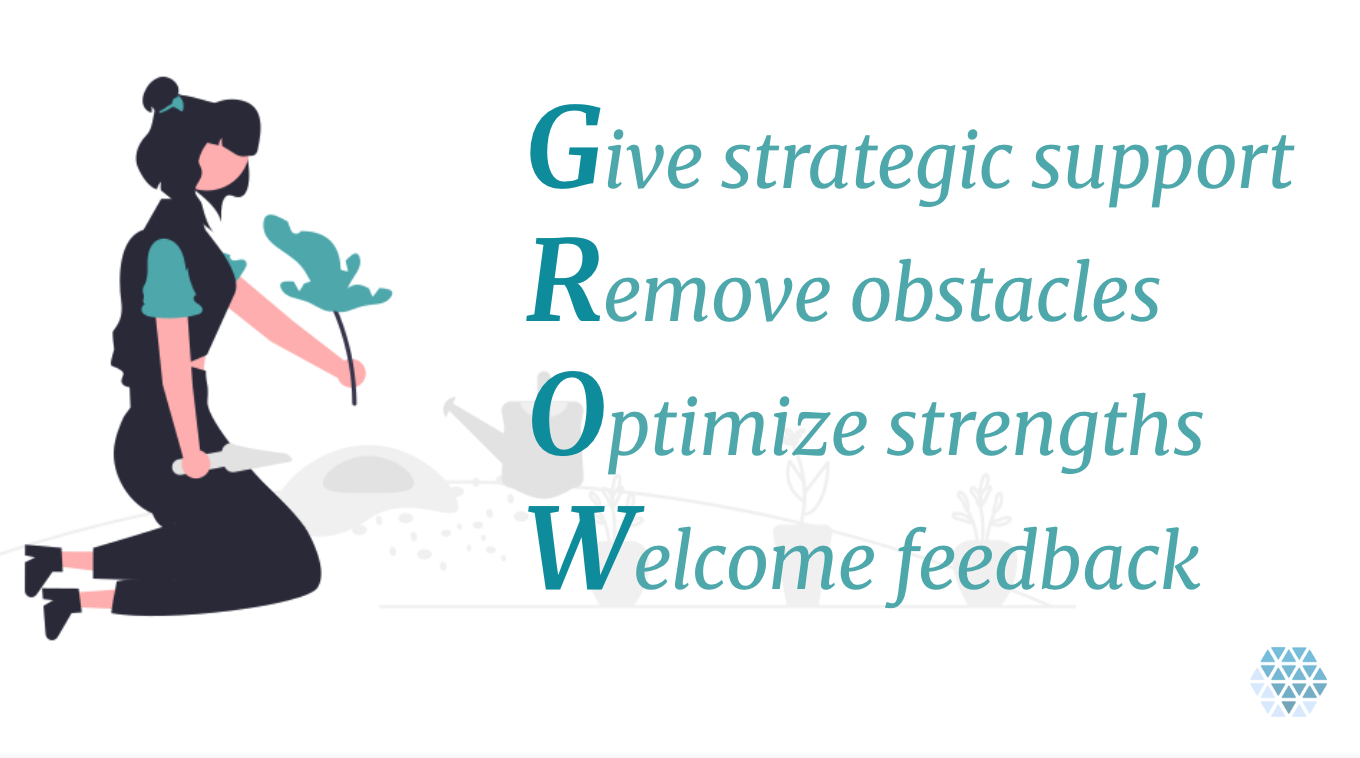
I used to walk into sessions with three or four separate strategies. Good ones. People nodded, took notes, said it was helpful. Then nothing changed back at the building, not because the ideas were bad, but because nobody’s brain holds four unrelated things under pressure. It holds one structure.
GROW isn’t decoration. It’s a cognitive scaffold, the same move UDL asks us to make for students: organize information so the load is lighter and the follow-through is higher. Four letters. One structure. The same four moves that work for a second grader struggling with number sense work for the teacher down the hall who’s three years from burning out.
Here’s where each letter actually comes from, and one way to put it into practice.
G — Give Strategic Support
This is UDL 8.2, optimizing challenge and support. Not more support. Strategic support, aimed at what the school or district actually needs, not just one more initiative stacked on top of the last one.
The mistake I made for years: assuming that if I delivered strong content, everyone would benefit from it the same way. They don’t. Some teachers want someone to watch them teach and tell them what’s working. Some want to see the strategy modeled with their own students first. Some want one-on-one coaching time to think out loud. Some want to be left alone with the resource and circle back on their own schedule.
All of those are valid. None of them are the same.
Try this: Before your next round of support rolls out, ask your staff how they want to be supported, not whether they want it. Two ways, max. Then stop assuming and start designing around the answers. You don’t have the staffing to put a coach in every classroom, but you might have exactly enough to put one in the classrooms of the people who actually said that’s what they need. Learn more in this article published in ASCD’s Educational Leadership Magazine (May 2026), From Professional Development to Professional Learning.
R — Remove Obstacles
This is UDL 7.4, addressing biases, threats, and distractions. The barrier work we already know how to do for kids. We just stop doing it once the learner is old enough to have a paycheck.
The move here isn’t complaining about obstacles. It’s sorting them. Every obstacle a teacher names falls into one of three buckets: things they can control, things they can influence, and things they can’t touch at all. Most of us burn our limited time and energy on the third bucket. We argue about state policy in a staff meeting instead of fixing the one local thing we actually have power over.
Try this: Run a quick jot-and-sort with your team. Name the obstacles. Sort them into control, influence, and no control. Then only plan around the first two. It’s a small shift, but it’s the difference between a staff that feels heard and a staff that feels like venting accomplished something.
O — Optimize Strengths
This is UDL 9.1, recognizing expectations, beliefs, and motivations, backed by Gallup’s research that a strengths-based approach is the single best lever for improving the relationship between a manager and the people they manage. Same truth for a principal and a staff. Same truth for a coach and a teacher.
When I was running PL for math intervention across Broward County Public Schools, I had one follow-up assignment, one format, mandatory for recertification points. Teachers needed the credit, sat through the training, and still no more than 25 percent completed the follow-up. Not because they didn’t care. Because there was exactly one way to show it and for some people that was more cumbersome than seemed worth it.
I redesigned it to offer multiple ways to demonstrate the same learning. Completion went from less than 25% to around 90%!
Try this: The next time you ask staff to show evidence of implementation, give them more than one way to do it; a video clip, a work sample, a quick write-up, a conversation. Same expectation, same rigor. Just more than one door into the room.
W — Welcome Feedback
This is UDL 9.3, promoting individual and collective reflection, and it’s the letter people skip because they think they already know how to “give good feedback.” That’s not what this is about. This is about eliciting it on purpose and receiving it without getting defensive, which is a much harder skill than it sounds.
If the only avenue for feedback is an open-ended “any thoughts?” at the end of a long day, you’ll get the room temperature and not much else. Build the avenue on purpose: a quick form, a structured question, a pulse check. And then receive what comes back without flinching, because nobody trusts feedback from someone who can dish it out but can’t take it.
Try this: Replace “any feedback?” with one specific question: what’s one thing I could adjust to make this more useful? You’ll still occasionally hear about the room being too cold. But you’ll also start hearing the thing that actually moves you forward.
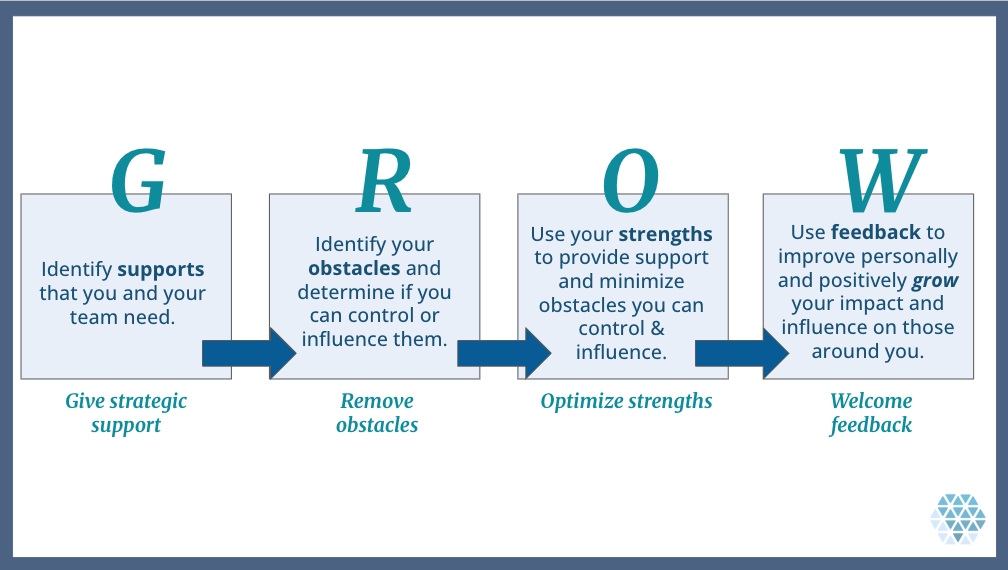
G.R.O.W. UDL Aligned Framework by Naomi Church
The Part That Ties It Together
“When a flower doesn’t bloom, you fix the environment in which it grows, not the flower.”
— Alexander Den Heijer
We don’t fix kids. We fix the system around them. The same is true for teachers. If a staff isn’t thriving, the first question isn’t what’s wrong with them. It’s what’s wrong with the environment they’re standing in.
G.R.O.W. isn’t a personality framework or a feel-good poster. It’s UDL applied upstream, to the adults who are supposed to be applying it downstream. Essential for some, useful for all.
I’m sharing the full G.R.O.W. visual breakdown, plus a one-pager you can bring straight into a staff meeting, on the resource page below. Enter your info and it’s yours.
Unlock the G.R.O.W. resource page ⬇️
