
Guest Blog: Foundations of Numeracy Part 1

Jillian Mendoza is the Director of Math at PowerMyLearning, where she works with schools and districts to build the kind of research-backed math systems that lead to lasting student outcomes. I first connected with Jillian at an NCTM conference, where we immediately found common ground in our passion for math education and our belief that strong instructional systems — not just strong lessons — are what move the needle for students. When she shared the work PowerMyLearning has been doing with the Foundations of Numeracy framework, I knew I had to bring it to this community. This is exactly the kind of big-picture, research-grounded thinking that school and district leaders need right now. I'm so excited to share it with you.
From Framework to Practice: Using the Foundations of Numeracy to Lead Research-Backed Math Instruction
Part 1 of a Two-Part Series: Understanding the Framework and Putting It to Work in Curriculum Decisions by Jillian Mendoza, Director of Math
A guide for principals, instructional coaches, and district leaders
Decades of research on how students learn math have quietly converged on a clear and consistent picture of what elementary students need to build lasting numeracy. The challenge for school and district leaders is not a lack of evidence, it is translating that evidence into coherent, school-wide action. PowerMyLearning’s Foundations of Numeracy framework offers a practical map for doing exactly that.
If you lead a school or district, you already know the terrain: curriculum adoption cycles, professional learning decisions, intervention placement, assessment analysis. Each of these decisions shapes whether students build a strong mathematical foundation or accumulate gaps that compound over time. What the Foundations of Numeracy framework provides is a shared language and structure for making those decisions with research behind them — and with the whole picture of numeracy in view, not just a slice of it.
What are the Foundations of Numeracy?
Just as Scarborough’s Rope transformed literacy instruction by illustrating how word recognition and language comprehension strands weave together into skilled reading, mathematics educators are now drawing on that same framework thinking to map the intertwined strands of numeracy. Rather than treating number sense, operations, and mathematical reasoning as isolated skills, this approach recognizes that true mathematical proficiency emerges from the complex braiding of multiple competencies developed simultaneously over time.
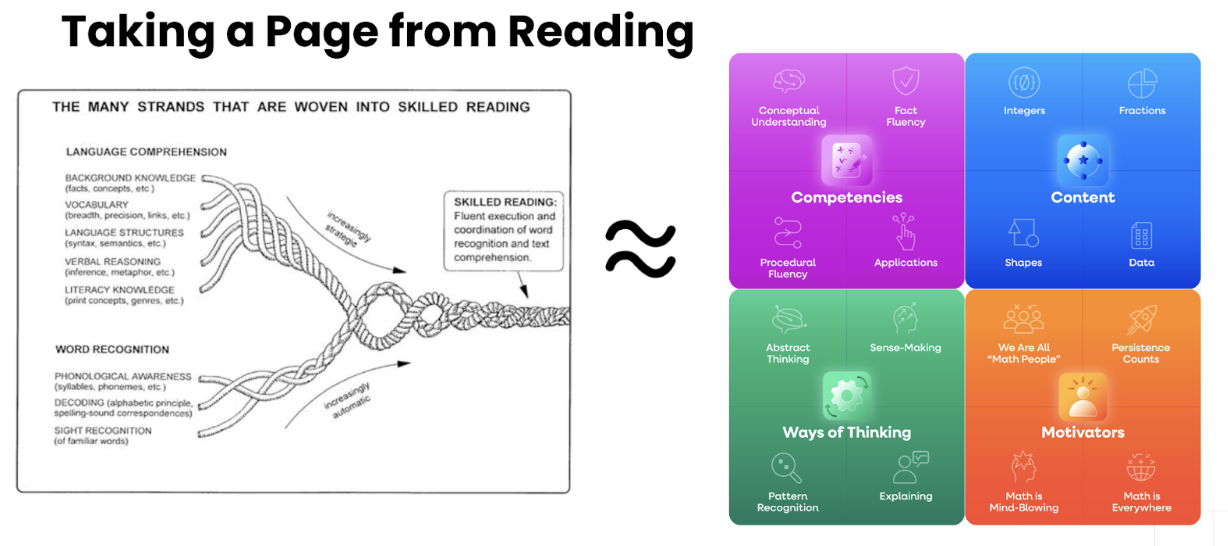
Scarborough’s Rope showed us that skilled reading is never just one thing — it’s the product of many strands working together. The Foundations of Numeracy framework borrows that same logic, recognizing that strong mathematical learners are built from Competencies, Content, Ways of Thinking, and the Motivators that keep them engaged.
The Foundations of Numeracyorganizes the evidence base for learning science, developmental psychology, pedagogy, and math instruction into four cornerstones, each containing the building blocks that together define what it means for a student to be mathematically proficient in their early math career. Critically, the framework focuses on what students need to develop, not how teachers should teach it. This is a deliberate and important distinction for leaders: It means the framework can sit above curriculum choices, instructional approaches, and program selections, providing the destination against which all of those decisions can be evaluated.
“The goal is not to prescribe a curriculum. It is to give every decision-maker — from the superintendent to the instructional coach — a shared and comprehensive map of what students are building toward.” (Foundations of Numeracy, 2025)
Selecting and Evaluating High-Quality Instructional Materials
One of the highest-leverage decisions a district makes is selecting High-Quality Instructional Materials (HQIM). Research consistently shows that a strong curriculum is one of the most cost-effective levers for improving student outcomes, but evaluating math curriculum is hard when there is no shared framework for what “coverage” actually means. Most curriculum reviews focus on alignment to grade-level standards. The Foundations of Numeracy allows leaders to go deeper and ask:
Does this curriculum develop all four competencies, or does it lean heavily on procedures while underbuilding conceptual understanding?
Does it give adequate attention to fractions, which research shows is one of the strongest predictors of later algebra readiness?
Does it build the Ways of Thinking — like pattern recognition, sense-making, explaining — through the process of instruction, or are they treated as add-ons?
DISTRICT LEADERSHIP USE CASE: HQIM Adoption Rubric
Map your curriculum review rubric to the 16 building blocks. Require that any core materials under consideration demonstrate how they develop all four competencies — not just procedural fluency — and show explicit progression across content areas like fractions and integers from K–5.
INSTRUCTIONAL COACH USE CASE: Curriculum Audit with Teachers
Run a unit-level audit of your curriculum in a PLC: for the unit you’re about to teach, which cornerstone(s) does this unit develop most? Which are underrepresented? This surfaces gaps that coaches and teachers can address with instructional routines and supplemental tasks without abandoning the adopted curriculum.
Building Coherence Across the System
One of the most common failure modes in math instruction is fragmentation: a school that adopts a strong core curriculum but then surrounds it with programs and interventions that operate on different content progressions and sometimes conflicting instructional approaches. The result is that students experience math as a set of disconnected episodes, teachers receive contradictory professional learning, and instructional coherence breaks down.
The Foundations of Numeracy creates a shared anchor across all tiers of instruction. When the district’s core curriculum, supplemental tools, benchmark assessments, and professional learning are all reviewed through the lens of the Foundations of Numeracy, decision-makers can review systems for coherence and identify what’s missing or misaligned.
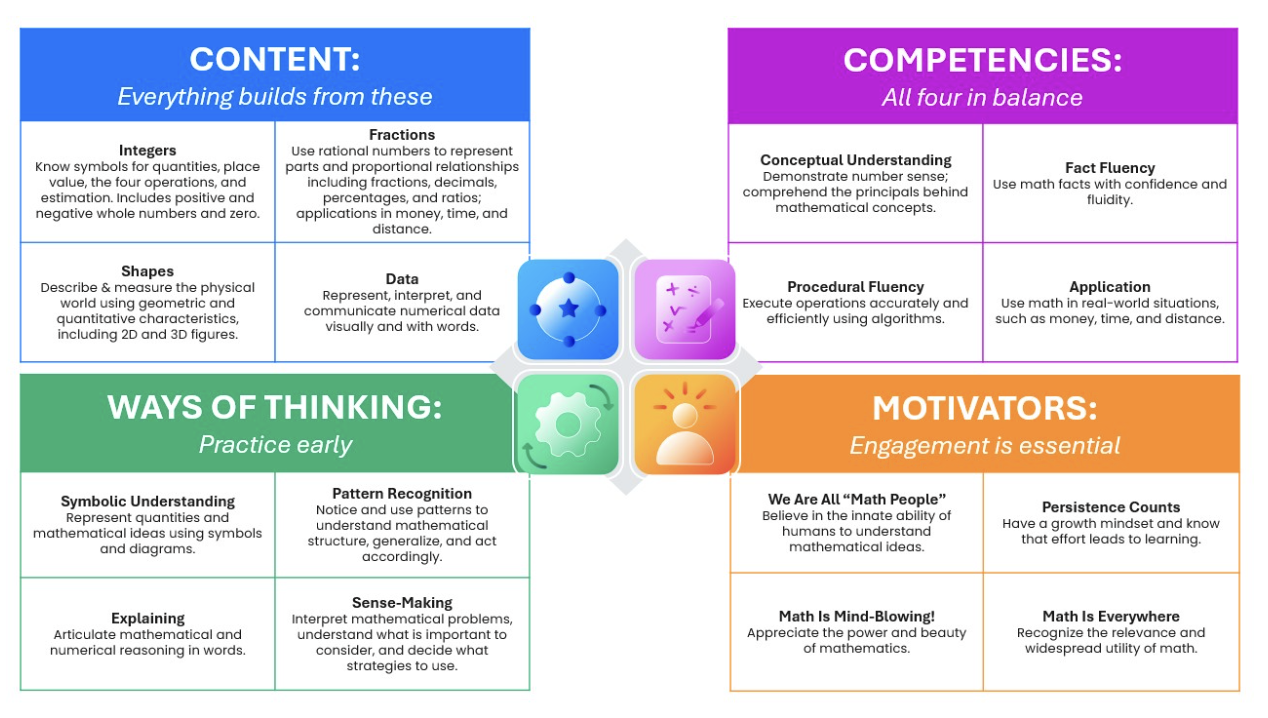
A KEY PRINCIPLE ON COHERENCE: The four Competencies in the Foundations of Numeracy are mutually reinforcing. They are not competing philosophies. Fluency with facts frees up working memory for complex problem-solving; conceptual understanding makes procedural steps meaningful and memorable. Leaders who understand this can resist the pressure to swing between approaches and instead hold both in productive balance. When professional learning, curriculum, and assessment all reflect this balance, schools stop re-litigating old debates and start building a coherent program.
DISTRICT LEADERSHIP USE CASE: Coherence Audit Across Programs
Map every math-related program or tool currently in use (core curriculum, fluency apps, intervention programs, tutoring) against the four cornerstones. Identify where the system overweights one cornerstone and underinvests in others. Use this map to rationalize your program portfolio and eliminate duplication.
PRINCIPAL USE CASE: School Math Vision Statement
Use the framework to write a one-page school-wide math vision that names all four cornerstones and describes what each looks like in your school. Share it with staff, families, and instructional coaches. When everyone speaks the same language about numeracy, instructional conversations become far more precise and productive.
INSTRUCTIONAL COACH USE CASE: PLC Focus Planning
Structure PLC agendas across the year so that each cornerstone receives dedicated attention. Examine student work and upcoming tasks from the curriculum through the lens of the four cornerstones. Identify learning experiences that help amplify particular cornerstones, or that would benefit from adaptations (e.g. revise learning experiences to incorporate Motivators).
When the framework guides how a system selects curriculum and builds coherence across programs, it becomes a living tool rather than a document that sits in a drawer. In Part 2 of this series, we’ll explore how the Foundations of Numeracy shapes intervention design, teacher professional learning, and ultimately, the outcomes for every student.
Read more about the Foundations of Numeracy here.
