
Grow Your Mind
Guest Blog: You Can't Reach Everyone the Same Way
Communication breakdowns in schools are rarely about intelligence or intention. They're about people with different communication styles talking past each other — and no shared language to name what's happening. Kathleen Kennedy of the Center for Communication & Engagement breaks down four Communication Operating Structures and what it looks like to actually meet people where they are.
Guest Blog: Foundations of Numeracy Part 2
EXCERPT
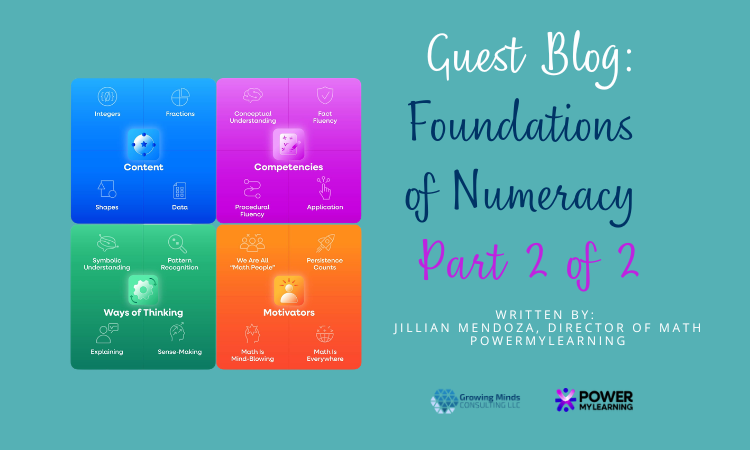
Research has given us a clear picture of what students need to develop lasting mathematical proficiency — but knowing the destination isn't enough. In Part 2 of this series, Jillian Mendoza of PowerMyLearning shows principals, instructional coaches, and district leaders how to put the Foundations of Numeracy framework to work where it's needed most: designing intervention that targets root causes rather than surface-level procedures, and building teacher professional learning that actually changes instruction. If your school or district is making intervention and PD decisions without a shared diagnostic lens, this is the read that reframes how you think about both.
Guest Blog: Foundations of Numeracy Part 1
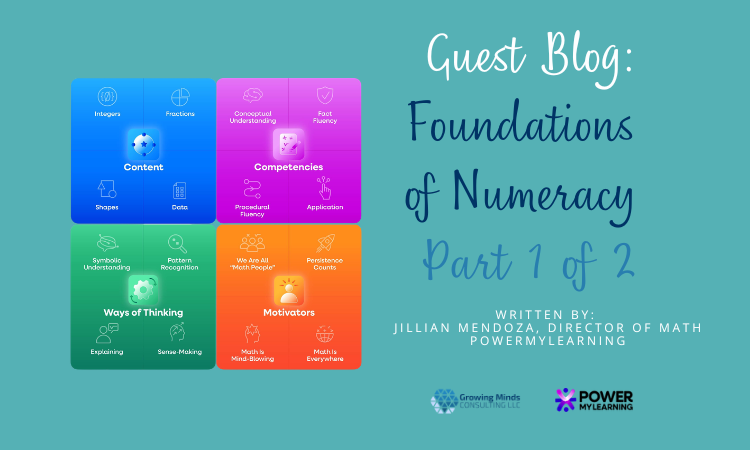
Decades of research have converged on a clear picture of what students need to build lasting mathematical proficiency — but translating that evidence into coherent, school-wide action is where many systems fall short. In this guest post, Jillian Mendoza, Director of Math at PowerMyLearning, introduces the Foundations of Numeracy framework: a research-backed map for making smarter decisions about curriculum, intervention, and instructional coherence. Whether you're a principal, instructional coach, or district leader, this framework gives you a shared language for evaluating every math decision — not just a slice of it, but the whole picture.

Podcast: Simplifying Professional Development with On-Demand Tools
Naomi Church joins Monica Burns on the Easy EdTech Podcast to discuss how on-demand tools can transform professional learning. This episode explores the difference between PD and PL, the role of UDL in adult learning, and practical ways to design professional learning systems that actually lead to change.

From Access to Empowerment: Key Updates in UDL Version 3.0
The release of the UDL framework version 3.0 by CAST on July 30, 2024, introduced several updates and shifts compared to version 2.2.

Guest Blog: Instructional Coaching as Collaborative Action Research
Over a decade ago, I had an amazing opportunity to be part of a year-long professional learning program for instructional coaching. As I listened to instructional coaches discuss their roles from across my state, I found that there were distinct differences in how we viewed our roles.