

Grow Your Mind
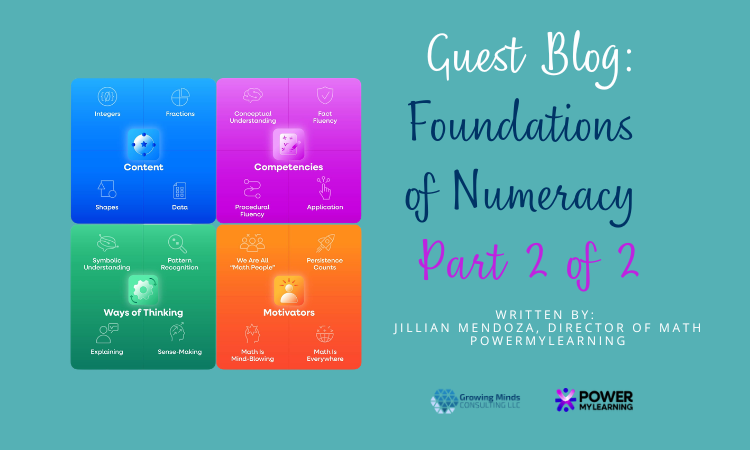
Guest Blog: Foundations of Numeracy Part 2
EXCERPT
Research has given us a clear picture of what students need to develop lasting mathematical proficiency — but knowing the destination isn't enough. In Part 2 of this series, Jillian Mendoza of PowerMyLearning shows principals, instructional coaches, and district leaders how to put the Foundations of Numeracy framework to work where it's needed most: designing intervention that targets root causes rather than surface-level procedures, and building teacher professional learning that actually changes instruction. If your school or district is making intervention and PD decisions without a shared diagnostic lens, this is the read that reframes how you think about both.
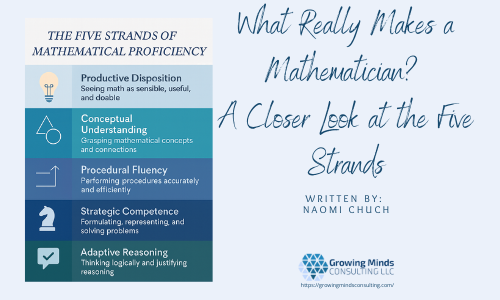
What Really Makes a Mathematician? A Closer Look at the Five Strands
It’s more than memorizing facts or following steps. This post breaks down the Five Strands of Mathematical Proficiency—productive disposition, conceptual understanding, procedural fluency, strategic competence, and adaptive reasoning—and shows how they work together to build confident, capable math thinkers. Whether you're designing instruction, planning PD, or coaching educators, this framework offers a powerful lens for supporting meaningful math learning.

The Power of Optimizing Strengths
What if instead of focusing on deficits, interventions and accommodations, we focused on student strengths and allowed students agency in their education so they can learn to leverage their own strengths?

Keywords are NOT the Key
I was asked to consult on a student Individualized Education Program (IEP) this week and it got me thinking about a presentation I gave a couple of years ago on the work of Karen Karp, Sarah Bush and Barbara Dougherty. They wrote an amazing article in Teaching Children Mathematics (Vol. 25, No. 7) entitled “Avoiding the Ineffective Keyword Strategy.”