
What Coherent Math Intervention Systems Have in Common
Early in my teaching career, I taught first grade in a converted storage room with a growing number of students with learning needs I had never been trained to address. What I lacked was not commitment, but a coherent intervention system. That experience shaped my career and still informs my view that mathematics intervention often fails less from lack of effort than from weak system design.
In schools across the country, mathematics intervention often breaks down in a familiar pattern: strong educator commitment, limited training in how to respond to persistent difficulty, and no clear system for identifying and addressing students’ most urgent needs. The problem is rarely effort. More often, it is design.
Over time, I have found that strong mathematics intervention systems tend to share four core design principles.
1. Target the priority educational need
Effective intervention starts by identifying the most important mathematical need to address first. When schools try to tackle every gap at once, intervention often becomes scattered and ineffective. Strong systems focus on the foundational need most likely to unlock broader progress.
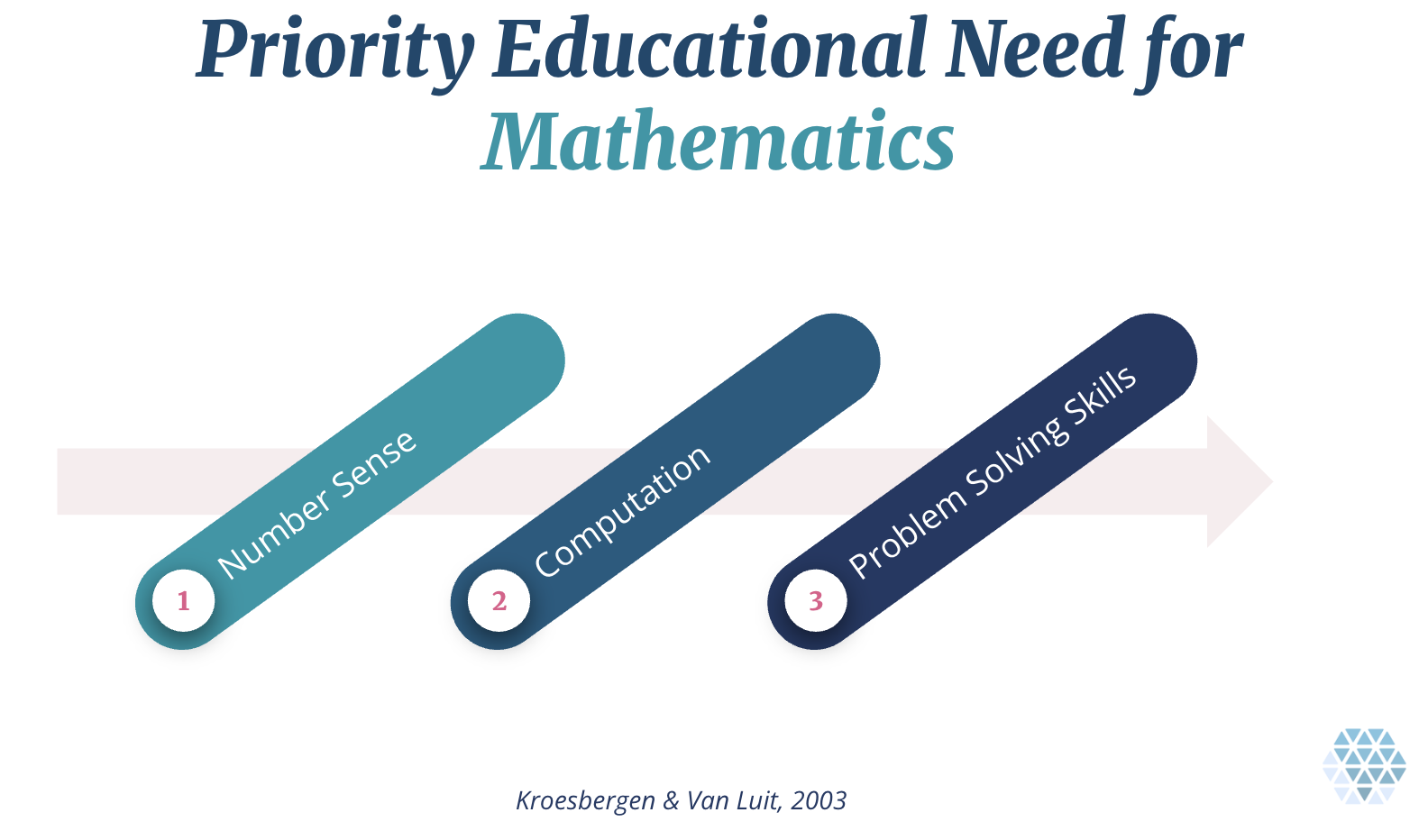
In mathematics, that progression typically moves from number sense, to computation and operations, and then to problem solving. You wouldn’t do a reading comprehension intervention for a student who is struggling with phonemic awareness or decoding. Likewise, implementing a problem solving intervention for a student with foundational gaps or misunderstandings in number sense won’t yield the desired results.
If students do not understand quantity, magnitude, place value, or relational thinking, then higher-level problem solving becomes an exercise in frustration rather than reasoning.
Check out this post to learn more about which diagnostic assessments to use to determine this priority need and to access my free intervention resources.
2. Systematic teacher-directed instruction
Students with persistent mathematics difficulty need more than extra practice or loosely supervised support. They need systematic, teacher-directed instruction that is intentional, responsive, and focused on the specific skill or concept that is blocking progress. Intervention cannot rest on a parent volunteer, a peer buddy, or only a computer program. It is typically more explicit than the teacher-directed instruction at Tier 1 because this remediation is for students who already have gaps and academic challenges.
3. Progress monitor frequently and skill-specifically
If intervention is targeting a specific skill, progress monitoring should show whether that exact skill is improving. Broad assessments like chapter and/or unit tests are not enough. Strong intervention systems rely on timely (likely weekly), focused data that helps educators determine when to continue, adjust, intensify, or fade support. That often means using curriculum-based measures and, when a specific intervention program is being used, program-embedded progress monitoring tools designed to measure growth on the targeted skills the program is intended to address.
4. Implement with fidelity while preserving coherence
Intervention is more likely to work when it is implemented consistently, with enough time, frequency, and instructional focus to make a difference. There is an important difference, though, between following general research-based guidelines for effective intervention (which is appropriate when using strategies for intervention) and following the specific implementation guidelines of a particular program. If a school is using a named intervention program, fidelity means adhering to the dosage, sequence, pacing, and instructional conditions under which that program was studied and its efficacy was established. At the same time, intervention should still connect to core mathematics instruction and help remove barriers to grade-level learning rather than functioning as a disconnected side system. If students cannot generalize the concepts to use in core math and real life, then the intervention isn’t doing what it’s supposed to.
Coherence is the real goal
The strongest mathematics intervention systems are not defined by how many tools they use. They are defined by the coherence of the instructional decisions behind them.
If schools want mathematics intervention to produce stronger results, coherence has to come before programs.
That kind of coherence does not happen by accident. It happens through intentional design.

At Growing Minds Consulting, we help design those systems. To access additional resources including a replay of Naomi talking about these ideas in the Online Thrive Conference, join our community for free.
