
Why T.R.U.E. Diagnostic Assessments Matter in Math
(And Why Not All “Diagnostics” Are Created Equal)
Lately, the word diagnostic has been stretched so thin in math education that it has almost lost its meaning. Many tools labeled as diagnostics are given multiple times a year, generate scale scores, and are primarily used for placement or progress monitoring. Those tools can absolutely have a place, but let’s be clear. They are not T.R.U.E. diagnostic assessments.
Many widely used tools support screening, placement, and progress monitoring effectively. Those purposes are different from a T.R.U.E. diagnostic assessment, and treating them as interchangeable creates confusion.
Within an MTSS framework, diagnostic assessments serve a very specific purpose. They are not meant to rank students, produce growth charts, or replace strong Tier 1 instruction. Their role is much more targeted, and much more important.
T.R.U.E. diagnostics help educators understand why a student is struggling and where instruction needs to be focused next.
What Actually Makes an Assessment a T.R.U.E. Math Diagnostic?

Not all assessments serve the same purpose - clarity matters.
A math diagnostic assessment should be TRUE, not just in name but in purpose. These are the non-negotiable elements, organized in an easy-to-remember format.
T — Trustworthy
A true diagnostic is valid and reliable, with strong technical evidence (psychometrics) showing that it measures what it claims to measure consistently and accurately.
R — Referenced to Norms
True diagnostics are norm-referenced. They allow teams to compare a student’s performance to a nationally representative peer group and understand the intensity of need.
U — Used with Intention
Diagnostics are not designed for frequent administration. They are used purposefully, typically once a year, or when an alternate form and a clear instructional reason exist (such as evaluating response to intervention).
E — Explicit About Skill Gaps
A true diagnostic goes beyond a single score. It clearly identifies strengths and gaps across math domains so instruction can be targeted with precision.
The Role of Diagnostics in MTSS
When used correctly, diagnostic assessments help teams:
Confirm and clarify concerns identified through universal screeners
Pinpoint specific skill gaps to guide Tier 2 and Tier 3 intervention planning
Make instructional decisions grounded in data, not assumptions
Provide defensible documentation when more intensive support is needed
This is a critical piece of making MTSS actually work in math, something I unpack more deeply in this post on Every Student, Every Tier: Making MTSS Work in Elementary Math, which also includes a free white paper you can use with your team.
Put simply, diagnostic assessments help teams move from “This student is struggling” to “Here’s exactly what instruction needs to target.”
A Quick Reality Check
There are very few math assessments on the market that truly meet these criteria and are practical for school use. That gap is one I see districts wrestle with all the time.
That’s why I created a concise reference chart highlighting four well-established, norm-referenced math diagnostic assessments: TEMA-3, TOMA-3, KeyMath-3, and CMAT-2, and the key features they share.
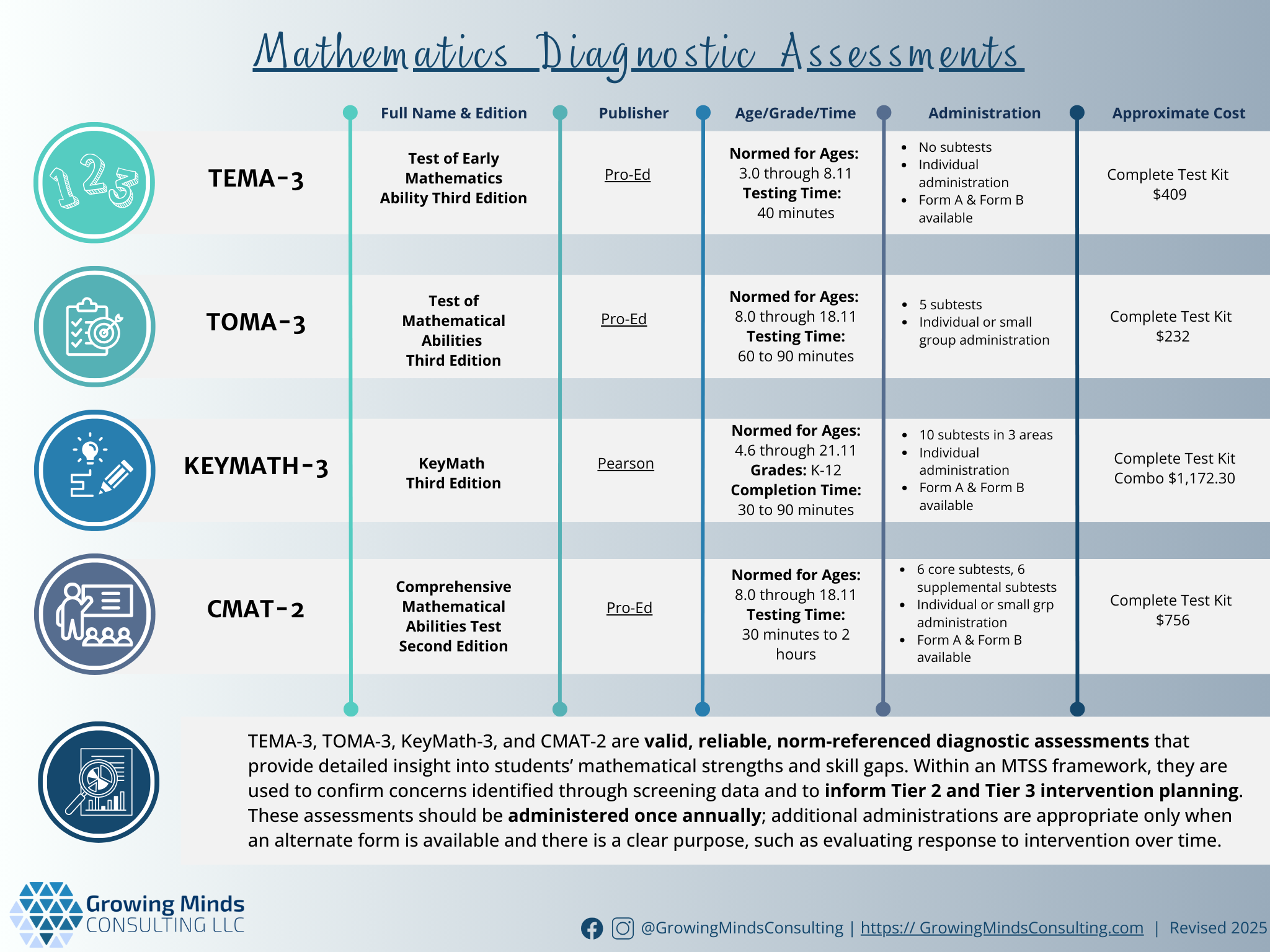
This resource is designed to help educators and leaders:
Identify which tools are appropriate for diagnostic use
Avoid over-testing or misusing assessments
Make more informed decisions within an MTSS framework
Because when it comes to diagnostics, precision matters - and not everything labeled “diagnostic” earns the title.
Access the full Math Diagnostic chart PDF, the T.R.U.E. framework infographic, and additional math intervention resources below ⬇️.
If your team would benefit from deeper support around assessment literacy, MTSS in math, or instructional decision-making, you can explore my educator workshops and keynotes here.
