
Guest Blog: When the System Gets Disrupted
This guest post expands the conversation beyond mathematics to explore a broader question I care deeply about: how classroom design shapes who does the thinking? While my work often centers on high-quality math instruction, intervention, and professional learning, the underlying principle is the same across content areas: learning improves when we design environments that reduce passive compliance and increase meaningful engagement. This perspective also connects closely to Universal Design for Learning, which reminds us that learners are variable and that participation, sense-making, and visible thinking should not be reserved for the quickest responders or most confident students. In this post, Robert Mayfield, Coordinator of Language and Literacy at the San Joaquin County Office of Education, reflects on how disrupting traditional classroom routines in history and social studies can open up more inclusive, engaging opportunities for students to think, contribute, and learn.
Building Thinking Classrooms in History & Social Studies: When the System Gets Disrupted
by: Robert Mayfield
Why changing the environment changes the thinking.

Ten years into my teaching career, a student changed the way I saw my classroom. His name was TJ.
It was near the end of the school year, and we were having a conversation about feedback. I asked students what I could do better as a teacher. It was the kind of question teachers ask when they want honest input but secretly hope students will say everything is fine.
TJ raised his hand. He was respectful. Calm. Thoughtful. And then he said something that hit me like a punch to the gut.
“Mr. Mayfield… it feels like the same five students raise their hands and answer questions all year.”
That was it. He didn’t accuse me of inequity. He didn’t say I talked too much. He didn’t say most students never got to participate, but that was exactly what he meant. And he was right.
For nearly a decade I had been teaching history the way most of us were taught to teach it: lecture-heavy, teacher-centered, built around notes, packets, and worksheets. I would pose quick questions to the class and call on the hands that went up first; the same reliable few students who always had answers ready. Meanwhile, the rest of the class sat quietly. Watching. Complying.
I had convinced myself that because students liked me (because they laughed at my dry sense of humor and responded to the energy I brought to the room) things were working. But in reality, most students were simply watching the show. I was the performer on stage. They were the audience. And I didn’t fully realize it until TJ pointed it out.
The Silent Crisis in Our Classrooms
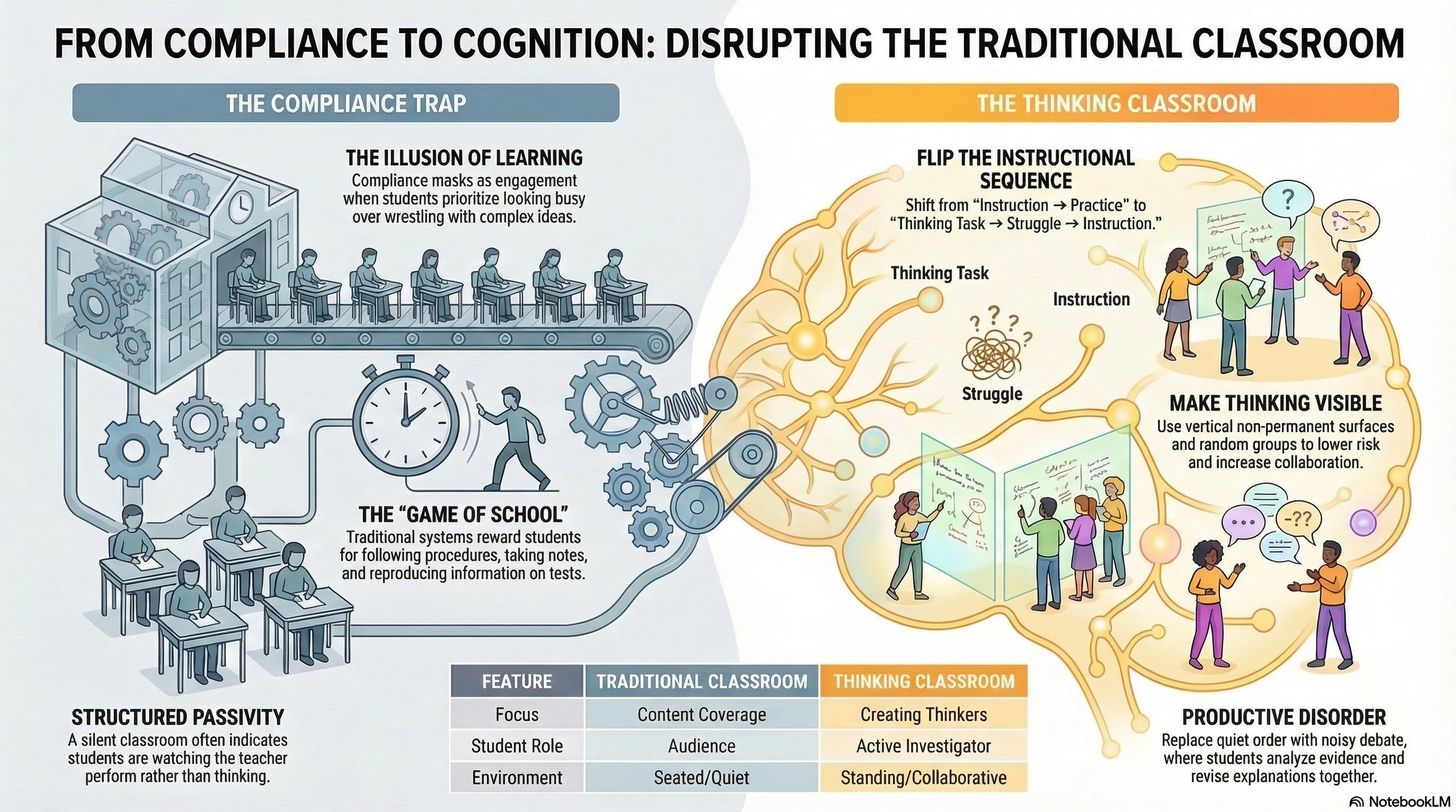
Walk into many history classrooms and you’ll see something that looks like learning: students writing quietly, notebooks filling with timelines and definitions, highlighters gliding across textbooks, worksheets completed and turned in. From the outside, it looks productive. But look closer…
Much of what we call engagement is actually compliance. Students memorize timelines but rarely debate causality. They copy notes but rarely construct arguments. They complete assignments but rarely struggle with ideas. Over time, students become very good at playing what many educators call the game of school.
They learn how to:
stall while looking busy
mimic procedures
copy information
complete tasks efficiently
And because the work gets done, the system appears to be functioning. But underneath the surface, something important is missing.
Thinking.
The real crisis in education isn’t apathy. It’s structured passivity.
The 200-Year-Old Classroom
Part of the reason this pattern persists is that the structure of school hasn’t changed much in centuries.
Most classrooms still follow a familiar instructional sequence:
The teacher explains the content
Students take notes
Students practice what they heard
Students take a test
It feels logical. First understand, then apply. But this model often produces mimicking instead of thinking. Students become skilled at reproducing information rather than constructing explanations.
Building Thinking Classrooms flips this sequence.
Instead of: Instruction → Practice
The process becomes: Thinking Task → Productive Struggle → Instruction
Students encounter a problem first. They attempt to reason through it with peers. They test ideas, debate possibilities, and revise their thinking. Only after that productive struggle does the teacher step in with guidance.
This challenges a deeply rooted belief about teaching: that students must understand something before they attempt to think about it. But in reality, thinking is often the very thing that helps understanding develop. And nowhere is that more important than in history and social studies. History is not a list of names and dates. It is an ongoing investigation into cause, consequence, and perspective.
The AP Student Paradox
Interestingly, some of the biggest challenges I faced when shifting my classroom came from students who were supposedly the strongest learners. My AP students.
I taught AP U.S. History, AP Government, and AP Human Geography. These classes were filled with students who had mastered the game of school. They knew how to succeed in traditional classrooms: take detailed notes, complete the packets, study just enough for the test, earn the grade. And to be honest, I helped reinforce that system with more lectures, notes and compliance.
When I began introducing Building Thinking Classrooms practices such as thinking tasks, collaborative reasoning, visible problem-solving, something surprising happened. Many of my AP students struggled. Not because they weren’t capable. But because their entire system of success had been built around watching the expert in the room. Me.
They had learned that the safest path to success was to listen carefully, take notes furiously, and reproduce information when asked. Now the system had changed and suddenly they had to wrestle with ideas before being given answers. And the system pushed back, because systems always do when they’re disrupted.
Change the Room, Change the Thinking
One of the most powerful ideas behind Building Thinking Classrooms is that thinking changes when the environment changes. In traditional classrooms, thinking can hide. Students sit behind desks with notebooks open. It’s difficult to see who is actually reasoning through ideas and who is simply copying information. Thinking classrooms disrupt that environment.
Students work at vertical non-permanent surfaces namely whiteboards, windows, or erasable panels while standing. This simple shift changes everything. Mistakes become low-risk because work can be erased instantly. Ideas become visible to everyone in the room. Students compare strategies and challenge each other’s reasoning.
Movement increases energy. Conversations emerge naturally. Another important shift involves visibly random groups. Instead of carefully constructed groups or self-selected partners, students work with randomly assigned peers in ways they can see and trust. The social dynamics of the classroom change and participation spreads more evenly. Students rely on one another rather than waiting for the teacher. Most importantly, thinking becomes visible. You can literally see it happening around the room.
Productive Disorder
At first glance, thinking classrooms can look chaotic: students are standing, voices overlap, whiteboards fill with arrows, diagrams, and half-formed ideas. For teachers accustomed to quiet, orderly classrooms, this environment can feel uncomfortable. But what looks like disorder is often the visible surface of real intellectual work.
Traditional classrooms prioritize calm and control. Students work quietly, complete tasks, and follow instructions. But calm does not always mean thinking. Thinking classrooms are different: they are noisier, students debate interpretations, groups revise explanations and ideas evolve through conversation. The room may appear less organized, but the thinking inside it is far more organized. Students are analyzing evidence, testing ideas and revising explanations. They are doing the intellectual work that learning requires.
Thinking Differently About School
The truth is, meaningful change in education rarely happens by accident. It happens when educators become willing to challenge long-standing assumptions about how classrooms should operate.
It happens when teachers start asking uncomfortable questions.
If my classroom is quiet, are students actually thinking?
Who is doing most of the intellectual work in this room?
Am I covering content… or creating thinkers?
For years, I believed that delivering strong lectures and keeping students engaged with humor and energy meant I was teaching well. TJ helped me realize something important: students might enjoy the show, but that doesn’t mean they’re doing the thinking. And if students aren’t thinking in our classrooms, then we have to be willing to rethink how those classrooms work.
Because if we want students to think differently…we may have to teach differently.
This article was edited in collaboration with ChatGPT, an AI language model developed by OpenAI.
